
A few years ago, if you told a pet food brand manager that insects would end up in their bestselling product, they would have laughed you out of the room.
Today, that same manager is probably on a sourcing call trying to lock in a mealworm protein supplier.
Something shifted in the pet food industry — and it happened faster than most people expected. Mealworm protein went from “interesting novelty” to “serious ingredient conversation” in less time than it took the organic pet food trend to do the same thing a decade ago. The question worth asking is: why? Is this just marketing? Greenwashing with a bug on the label?
Not really. Let’s go through what’s actually driving it.
The Market Is Moving — Whether You’re Ready or Not
The EU authorized mealworm as a feed ingredient for cats and dogs in 2021. In the same year, several major European pet food brands quietly launched insect-protein product lines. By 2023, insect-based pet food had gone from specialty health store shelves to mainstream online retail platforms in the UK, Germany, Netherlands, and increasingly the US market.
The global insect protein market for pet food specifically is projected to grow at a CAGR of 23.8% through 2028 (MarketsandMarkets, 2023). That is not a niche number. That is a structural shift.
Brands are not choosing mealworm protein to be trendy. They are choosing it because their customers are asking for it — and because the supply chain is finally mature enough to support it at commercial scale.
Sustainability Is the Reason Brands Can Talk About It Publicly
Here’s the thing about sustainability claims in pet food: consumers are increasingly good at spotting the ones that don’t hold up. Vague commitments to “responsible sourcing” don’t move product anymore. But mealworm protein gives brands something concrete to point to.
The numbers are genuinely compelling.
Producing 1 kg of mealworm protein requires:
- ~2 liters of water (compared to 1,000+ liters for beef protein)
- ~2.5 m² of land (compared to 200+ m² for beef)
- ~2 kg of feed (feed conversion ratio of roughly 2:1)
- Generates ~1–2.7 kg CO₂ equivalent (compared to 25–30 kg for beef)
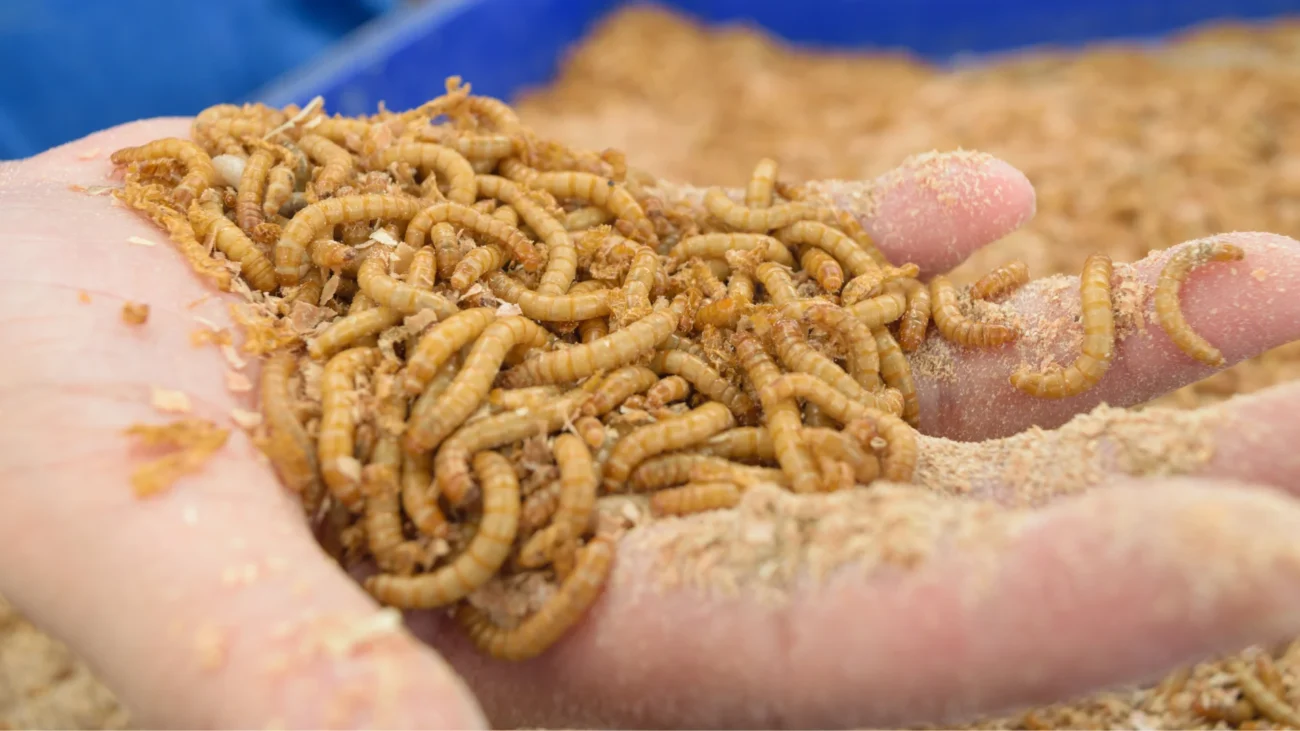
Mealworms can be raised on agricultural byproducts — wheat bran, vegetable trimmings, grain residues. They produce frass (a high-quality organic fertilizer) as a byproduct. They require no antibiotics. They generate no bycatch.
For a pet food brand trying to build a credible sustainability story — one that holds up to scrutiny and doesn’t collapse under a journalist’s fact-check — mealworm protein is one of the few ingredients that actually delivers on the promise.
That matters in marketing. It matters more in brand reputation.
The Hypoallergenic Angle — This One Is Genuinely Underappreciated
Okay, this is the part of the mealworm protein story that doesn’t get talked about enough. And for pet owners with dogs or cats that have food sensitivities, it might actually be the most important section.
Food allergies and intolerances in pets are more common than most people realize. Estimates suggest that 10–15% of all dogs experience some form of food-related skin or gastrointestinal reaction. The most common culprits? Chicken, beef, dairy, and wheat — which happen to be the four most common protein and carbohydrate sources in conventional pet food.
The standard veterinary recommendation for a food-allergic pet is a novel protein diet — a protein source the animal has never been exposed to, so the immune system has no existing reaction to mount. Historically that meant duck, venison, kangaroo, or rabbit. All of which are expensive, hard to source consistently, and carry their own environmental footprint.
Mealworm protein is a genuinely novel protein for the vast majority of dogs and cats. The immune system has no prior sensitization to it, which means it is unlikely to trigger an existing allergic response.
But it goes further than just “novel protein.” Mealworm protein has a distinct protein structure from mammalian and avian proteins, which appears to reduce cross-reactivity — meaning even pets with multiple protein allergies often tolerate insect-based diets without issue.
A 2019 study published in the Journal of Nutritional Science found that 92% of dogs with diagnosed food allergies showed no adverse reaction to an insect-protein diet over a 12-week trial period. A 2022 study in Veterinary Dermatology reported significant improvement in skin condition scores in allergic dogs fed an insect-based diet.
This is not marketing language. These are peer-reviewed outcomes.
For brands formulating for the sensitive pet segment — which is a growing and loyal customer base with high willingness to pay for solutions that actually work — mealworm protein is not a compromise. It is a genuine functional advantage.
Consumer Acceptance — The “Ick Factor” Is Fading, Fast
Let’s be honest about the elephant in the room — or in this case, the insect in the bowl.
When insect-protein pet food first came up in consumer research, the response from pet owners was predictable. “I’m not feeding my dog bugs.” Full stop. The concept had an immediate gut-reaction barrier that made marketers nervous.
That barrier is eroding. Quickly.
A 2022 consumer survey by Mintel found that 47% of US pet owners said they would consider insect-protein pet food for their animal, up from 28% in 2019. In the UK, that number was 54%. In Germany and the Netherlands — where insect protein regulation moved earlier — acceptance rates among premium pet food buyers exceeded 60%.
What This Means If You Are a Pet Food Brand
If you are formulating a new product line or reformulating an existing one, the practical consideration is straightforward: mealworm protein is not a gimmick ingredient you add for the packaging story. It is a functional, nutritionally complete protein source with documented hypoallergenic properties, a genuine sustainability profile, and growing consumer acceptance in your most important demographic.
The supply chain question — “can I actually get consistent quality at volume?” — is the one that held brands back three or four years ago. That question has a better answer now.
At GreenFut Biotech, we supply defatted mealworm protein powder from a vertically integrated operation producing over 6,000 tons of dried mealworm annually. FDA and ISO22000 certified. Consistent protein specification across batches. Available in bulk for industrial feed formulation.
If you are a pet food brand, a contract manufacturer, or a formulation house exploring insect protein inclusion, we can provide specification sheets, third-party lab reports, and trial samples.