
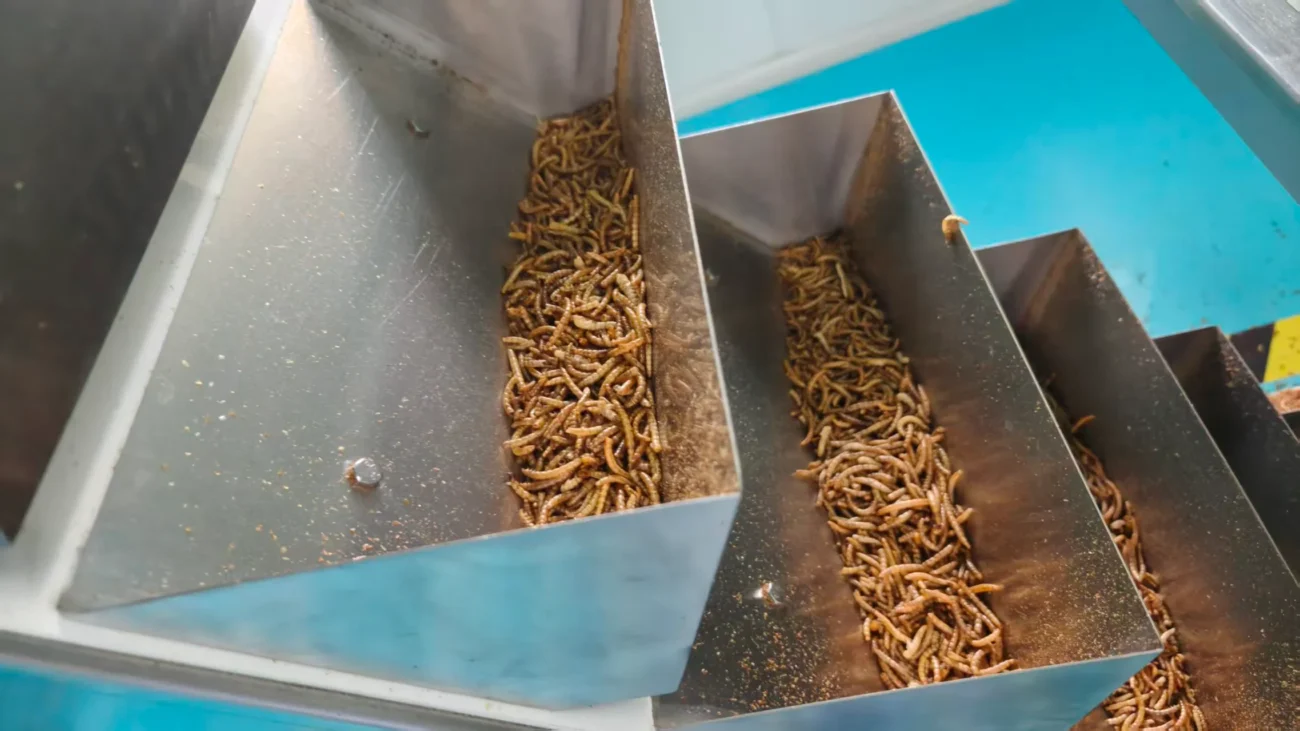
Are you buying something that sits whole in a bag on a shelf, or an ingredient that disappears into a formula? The answer changes almost every requirement for a dried mealworms supplier, from size and appearance to documentation and handling. Many orders get complicated because the buyer and the seller are picturing different products.
Whole dried mealworms: appearance and consistency
For dried mealworms for bird feed or pet treats, customers look at the product. Size, colour, breakage, odour and the amount of dust or foreign matter in the bag are all visible, and a bag that looks different from last season’s generates complaints and returns. Moisture is the other key figure, because it affects stability and storage. A distributor selling to wild-bird feeders also cares about dependable supply during the months when demand peaks, so discuss forecasts early.
Mealworm protein powder: composition and behaviour
For formulated pet food or feed, the focus shifts to what the ingredient does inside the recipe. A mealworm protein powder supplier should be able to talk about composition, particle size, flow properties, packaging and how the powder behaves in blending. Powder and whole insects are not interchangeable weight for weight, because composition and functional behaviour differ. Trial the powder in your actual formulation before committing to a large volume.
What a useful specification contains
“High quality” is not a specification. Look for measurable items: moisture limit, foreign-material controls, size distribution, colour variation, odour, package integrity, and, where relevant to the application, nutritional and microbiological test data. Ask which tests are available and how results link to each batch. Also find out how raw material is handled before and after drying, since processing and storage conditions affect stability. Agree in writing what counts as an acceptable batch, and what notice you get if the specification changes.
Size deserves its own line. Mealworms are sold in different grades, and a bag labelled with one grade can still contain a wide spread. If a feeder or treat container needs a particular range, put the range in the specification and check each incoming lot by measuring or sieving a handful. For powders, check particle size in the same way, because a coarse lot behaves differently in a mixer than a fine one.
Wholesale supply and traceability
For dried mealworms wholesale orders, the second and tenth shipments matter more than the first. A supplier may have large overall capacity while particular sizes or package formats need extra planning, so confirm the exact specification and delivery schedule. Batch identification and record retention are what let you trace a problem to a specific lot and talk about it without ambiguity.
If the product will be sold under your own brand, raise private packaging, label languages and minimum quantities for printed bags early. Artwork and printing often set the lead time more than the product does.
Packaging, shipping and import rules
Dried products still need suitable packaging and storage. Confirm packaging material, net weight, labelling and pallet arrangement before production. For export, the rules for insect products differ between countries and between uses as feed, pet food or food, and can include restrictions on species, processing and documentation. The importer is responsible for checking what applies to the destination market and the intended use, and it is better to do that before production than at the port.
If you are evaluating a yellow mealworm manufacturer in China, or an insect protein supplier anywhere, the important point is how production, processing and export work together, and whether the product can be repeated shipment after shipment. The cheapest first quote rarely makes the best long-term partner. Greenfut Mealworms’ products, including dried mealworms and processed formats, can be reviewed on the official website: